
How to Specify Export-Grade Hardwood Lump Charcoal for Restaurants
Restaurant buyers do not need a generic promise of “premium charcoal.” They need a repeatable fuel specification that their chef, purchasing team, warehouse and freight partner can all understand. For hardwood lump charcoal, the practical brief starts with the cooking application and ends with a documented acceptance process: material, size range, moisture and ash expectations, sample approval, packing configuration and loading evidence. The goal is not to make every lot identical in appearance. It is to make the differences that affect service visible and agreed before shipment.
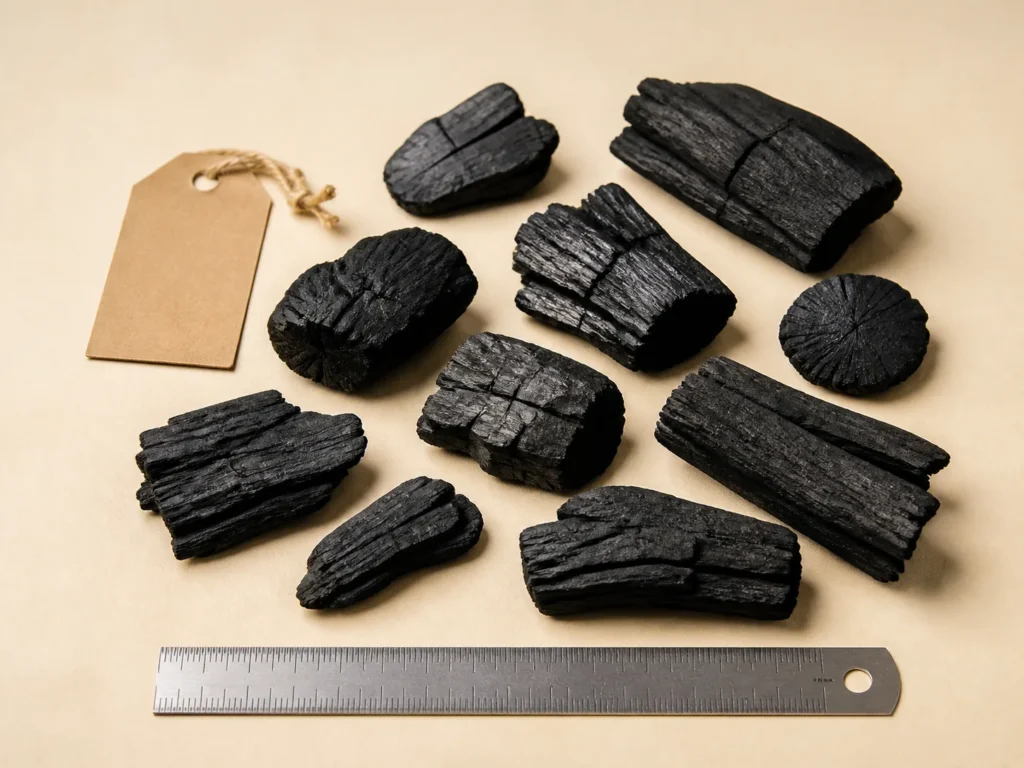
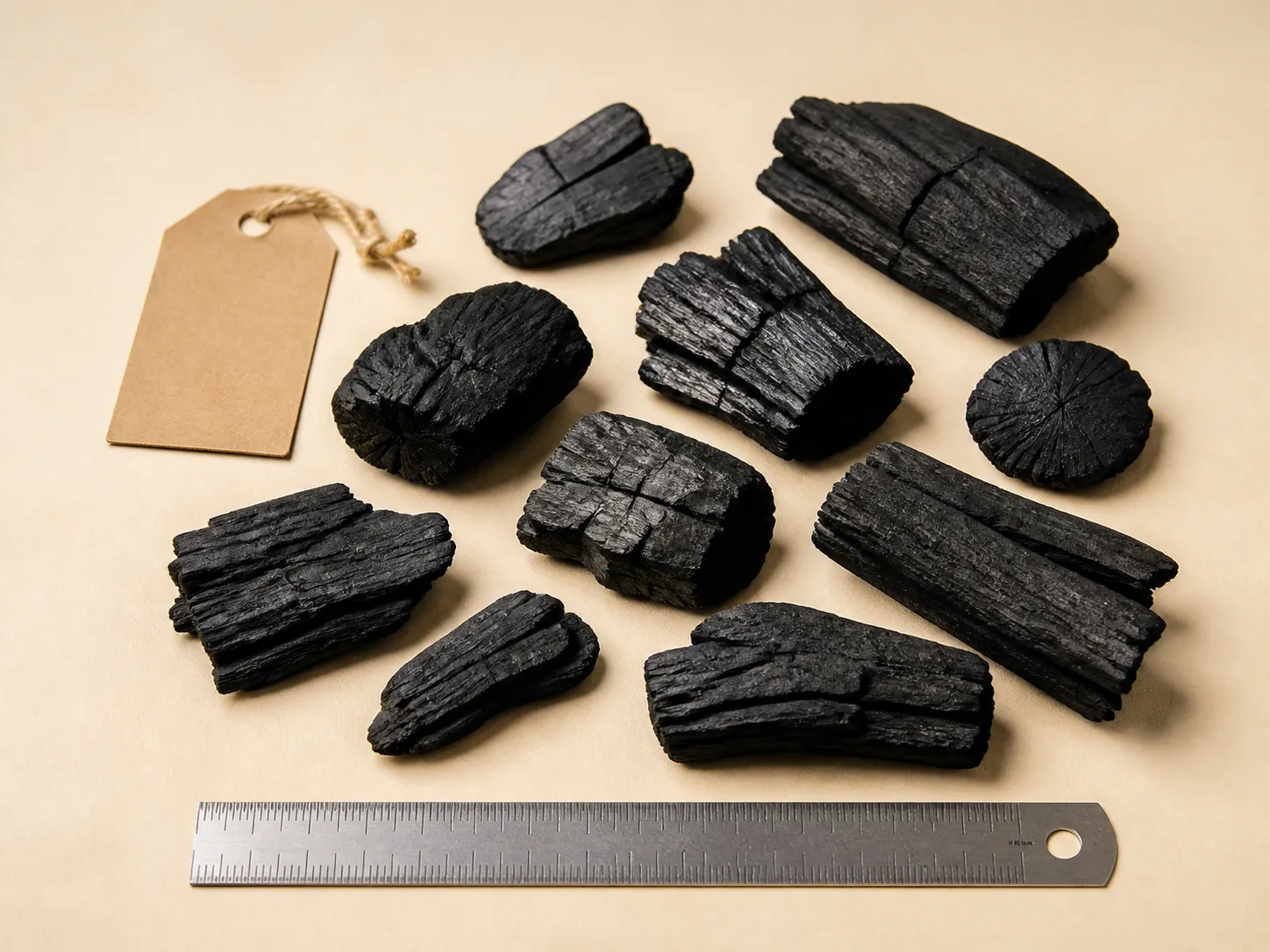
Hardwood lump charcoal is made from carbonized wood and naturally varies in shape. That variation can be useful for live-fire cooking, but it becomes a commercial risk when the buyer has not defined what counts as usable pieces, fines, oversized pieces or breakage. A written specification gives a supplier a target and gives the buyer a fair way to inspect the goods at arrival.
Start with the cooking job, not a grade name
Terms such as restaurant grade, steakhouse grade or export grade are commercial shorthand. They do not, by themselves, state a size distribution, heat profile, pack format or inspection method. Begin the buying conversation with the equipment and service pattern. A charcoal oven, a robata grill and an open grill station can all use lump charcoal, yet they may value different piece sizes and refuelling behaviour.
Ask the operating team four questions before requesting a quotation:
- What appliance is being used, and what fuel size can it safely accept?
- Does the kitchen need a long uninterrupted service period or frequent smaller refuels?
- How much visual dust is acceptable in the receiving and prep area?
- Will the product be sold in retail bags, used in a restaurant, or both?
The answers turn a broad product category into a useful starting brief. For example, a buyer may request a principal large-piece range for an open grill, a stated tolerance for smaller usable pieces and a separate maximum for fines. Another buyer may prefer a more compact range that is easier to dose into a smaller charcoal oven. Neither request is automatically better; each is a fit-for-use decision.
Buying principle: define the job first, then define the measurement. A sample may look attractive while still being unsuitable for the appliance, bag size or labour routine.
Build a specification that can be inspected
A practical charcoal specification does not need to imitate a laboratory textbook. It needs to identify the characteristics that control the buyer’s actual risk. The following fields are a sensible baseline for a hardwood lump charcoal purchase order or product sheet.
| Specification field | Why it matters | How to make it usable |
|---|---|---|
| Raw material description | Sets the product identity and sourcing discussion. | Name the material category and any agreed exclusions; do not imply certification that has not been supplied. |
| Piece-size range | Affects airflow, loading and the number of usable pieces in a bag. | State the intended range plus the allowed share of undersize and oversize pieces. |
| Fines and breakage | Influences housekeeping, ignition and perceived yield. | Agree a sampling point and an inspection method before production begins. |
| Moisture and ash limits | Provides a shared reference for quality control. | Record the test method, sampling basis, target and tolerance in the contract. |
| Bag and carton format | Controls shelf presentation, handling and freight packing. | Specify net weight, artwork version, inner bag, carton count and pallet plan where relevant. |
“Low ash” and “long burning” are often used as marketing phrases. A serious buyer should turn those phrases into an agreed testing and approval plan rather than assume they mean the same thing for every supplier. Results depend on material, carbonization, particle size, storage conditions, appliance airflow and operating practice. The best commercial document says what will be checked, when, by whom and what happens if a result is outside the agreed range.
Use samples as a decision tool
A pre-production sample is most useful when it is treated as a reference, not as a ceremonial formality. Photograph the sample beside a scale, record the bag format and note the intended use. If the team cooks with it, document the appliance, loading quantity, lighting method and the conditions that affected the result. This creates a clearer discussion than an informal statement that the charcoal “burned well.”
For a first order, consider a three-stage approval route:
- Desk approval: confirm product brief, size range, packaging and label claims.
- Physical approval: inspect a representative sample for usable pieces, dust, packing and basic handling.
- Lot release: review photos, count, pack plan and agreed inspection results before container loading.
This sequence is especially helpful when product decisions are made in one country while receiving happens in another. It reduces the chance that a buyer approves an attractive sample but receives a different size mix because the production instruction was not captured in writing.

Choose a size strategy for the outlet
Large pieces are frequently requested by restaurants because they are easy to sort visually and may suit certain grill configurations. However, a very narrow “large only” request can increase the amount of material that must be screened out during production. That may affect yield, availability, price or lead time. Conversely, an undefined mixed-size product can create too much dust and too many pieces that do not fit the cooking equipment.
A balanced brief distinguishes three categories: the main sellable range, acceptable smaller pieces and unacceptable fines. It also states how pieces will be measured. A sieve-based approach, a hand-screening method or a photographic reference can all work if both sides use the same method. The important point is consistency, not a particular method chosen for every market.
For restaurant programs, the right answer often includes more than one SKU. A larger format can serve open-fire venues, while a more compact format can serve hospitality distributors or smaller charcoal ovens. Keeping these SKUs separate in the sales sheet prevents a single product name from carrying conflicting expectations.
Packaging is part of product performance
Charcoal can be technically sound and still arrive with a poor first impression if the packaging does not protect it through handling. The bag is a transport component, a label surface and—in retail—a brand asset. Request a mock-up or artwork proof early, then confirm the carton dimensions, bag count and container loading pattern. If the buyer needs an OEM or private-label program, the packaging brief should cover more than logo placement.
- Net weight and permitted country-market labelling.
- Bag substrate, closure and print version.
- Retail carton or food-service outer pack.
- Handling marks, lot identification and traceability code.
- Photos required before and during loading.
Forest-based claims deserve particular care. If a buyer requests FSC-related material or labelling, the claim must match the applicable chain-of-custody status and approved documentation. FSC describes chain-of-custody certification as a system for identifying and tracking eligible forest-based material through the supply chain; it is not a generic sustainability adjective that can be added to artwork without evidence. Review the relevant FSC chain-of-custody guidance before approving a certification claim on a bag or sales sheet.
Plan the commercial handoff
Commercial clarity is usually more valuable than a long technical brochure. A buyer should receive a concise specification sheet, a sample reference, a packaging proof and a pre-shipment checklist. The supplier should receive the same approved documents, plus a clear instruction on who has authority to approve changes. This matters when a sales team, a packaging printer, a production line and a freight coordinator are all involved.
Before confirming an order, decide how deviations will be handled. Can an oversize piece be accepted if the bag remains within the overall pack requirement? Does a small change in carton artwork need written approval? What evidence is needed if the buyer asks for a lot inspection? Answering these questions before packing protects both sides from last-minute disagreement.
Primechar’s home page presents hardwood, coconut-shell and briquette charcoal as separate product routes. That separation is useful: compare like with like, and build a specification around the intended charcoal type instead of forcing one buying brief onto every product.
Compare quotations on usable value
A hardwood lump charcoal quotation is only comparable when the underlying brief is comparable. A lower price for a loosely described mixed-size product may look attractive beside a price for a screened restaurant-size program, yet the bags, usable yield, carton count and inspection obligations may be different. Ask each supplier to complete the same comparison sheet. This avoids the common habit of comparing price per container while overlooking how much product the kitchen can actually use.
The comparison sheet should show the agreed Incoterm, currency, net weight, number of bags, bags per carton, cartons per container, primary size range, stated treatment of fines, sample status, packaging version, production lead time and included evidence. If any item is unknown, mark it as open rather than silently assuming it matches a competitor’s offer. A quotation can still be commercially promising with open items; it simply should not be treated as a final like-for-like comparison.
For established buyers, a scorecard can make decisions more consistent. Score the factors that matter to the business—product fit, packaging readiness, response quality, sample outcome, documentation discipline and freight compatibility—rather than only unit cost. The score does not replace commercial judgement. It makes the reasons for a decision visible, which is helpful when different teams approve the product, negotiate the order and receive the goods.
🔎 Example: a restaurant distributor may accept a slightly higher ex-works price if the supplier provides an approved carton configuration, a clear lot record and loading proof that reduce receiving uncertainty. Another buyer may prioritise a simple bulk format because their own warehouse repacks the product. Both decisions can be rational when the specification explains the trade-off.
Restaurant charcoal specification checklist
- ✅ Name the cooking appliance and service pattern.
- ✅ State the main piece range, acceptable small pieces and maximum fines.
- ✅ Agree the method and timing for moisture, ash or other quality checks.
- ✅ Approve a physical sample and record what was approved.
- ✅ Lock the net weight, pack construction, artwork and outer-carton count.
- ✅ Define the pre-shipment evidence required before loading.
Frequently asked questions
Is hardwood lump charcoal always the best choice for a restaurant?
No. Hardwood lump charcoal may suit many live-fire applications, but the best choice depends on the appliance, service routine, desired piece shape, local supply chain and the buyer’s handling preferences. Coconut-shell or sawdust briquettes may be a better fit when a program requires a more uniform format.
What does export grade mean for charcoal?
Export grade should be treated as a commercial specification, not a universal standard. A usable export-grade definition includes the agreed product identity, size range, quality limits, packaging configuration, inspection process and shipping evidence.
How many samples should a buyer approve?
There is no single number. For a new product or private-label program, one physical sample plus an approved packaging proof and pre-shipment evidence is often more useful than receiving several untracked samples. The key is that every approval is recorded.
Can a supplier make an FSC claim for any hardwood charcoal?
No. FSC claims and labels require the relevant certification and chain-of-custody controls. Buyers should request current documentation and ensure the wording on packaging matches what is actually supported.
Why ask for loading photos?
Photos support a shared record of packaging condition, count, container preparation and loading sequence. They do not replace an agreed inspection method, but they make the shipping handoff easier to review across teams.
Conclusion
A reliable hardwood lump charcoal program is built around an inspectable brief. Specify the cooking job, agree the evidence, approve the product and packing references, then review the lot before shipment. That approach gives restaurant buyers a clearer purchasing decision and gives suppliers a practical target for production and export coordination. The brief can evolve with real service feedback, but every revision should be dated and approved so the next order is more predictable than the last.